AI Answers Fast. Data Engineering Decides if You Can Trust It.
The tools keep changing. The six things that make an answer trustworthy do not.
It takes an AI assistant about one second to answer a hard business question.
It takes a lot longer than that to earn the right to believe the answer.
That gap is where data engineering lives now. The model is fast. The question is whether the number it hands you is worth acting on.
Speed is not the hard part anymore
A few years ago, getting an answer was the work. You wrote the query. You waited for the cluster. You copied the result into a deck.
Today an assistant writes the query for you, runs it, and explains it in plain English. That part is close to solved.
What is not solved is the quiet question sitting under every answer. Where did this number come from, and would a careful colleague agree with it?
A fast answer built on unclear data is not a productivity win. It is a faster way to be wrong, with more confidence.
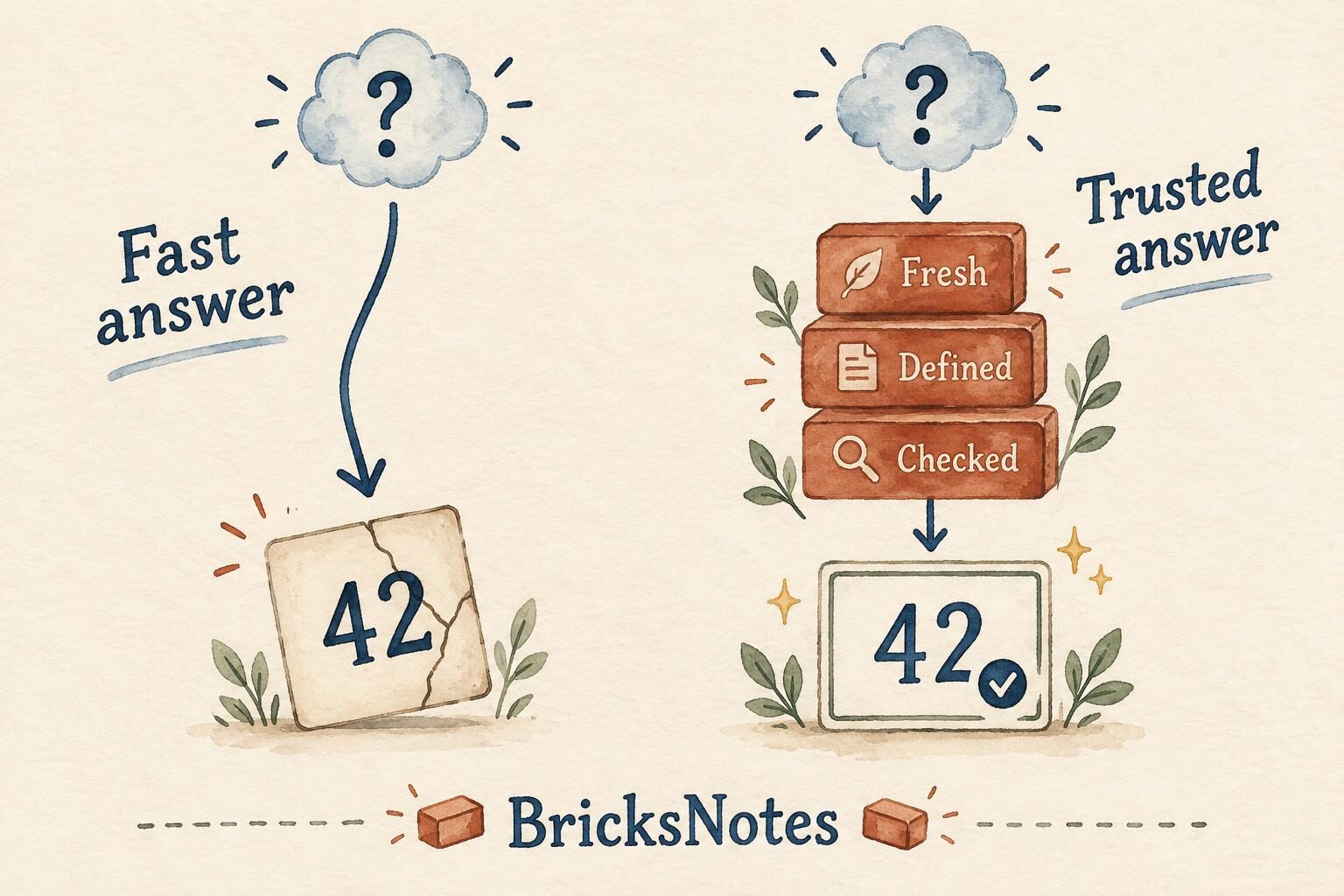
Trust comes from six basics
None of these are new. That is exactly the point. They were good practice before AI, and AI raised the cost of skipping them.
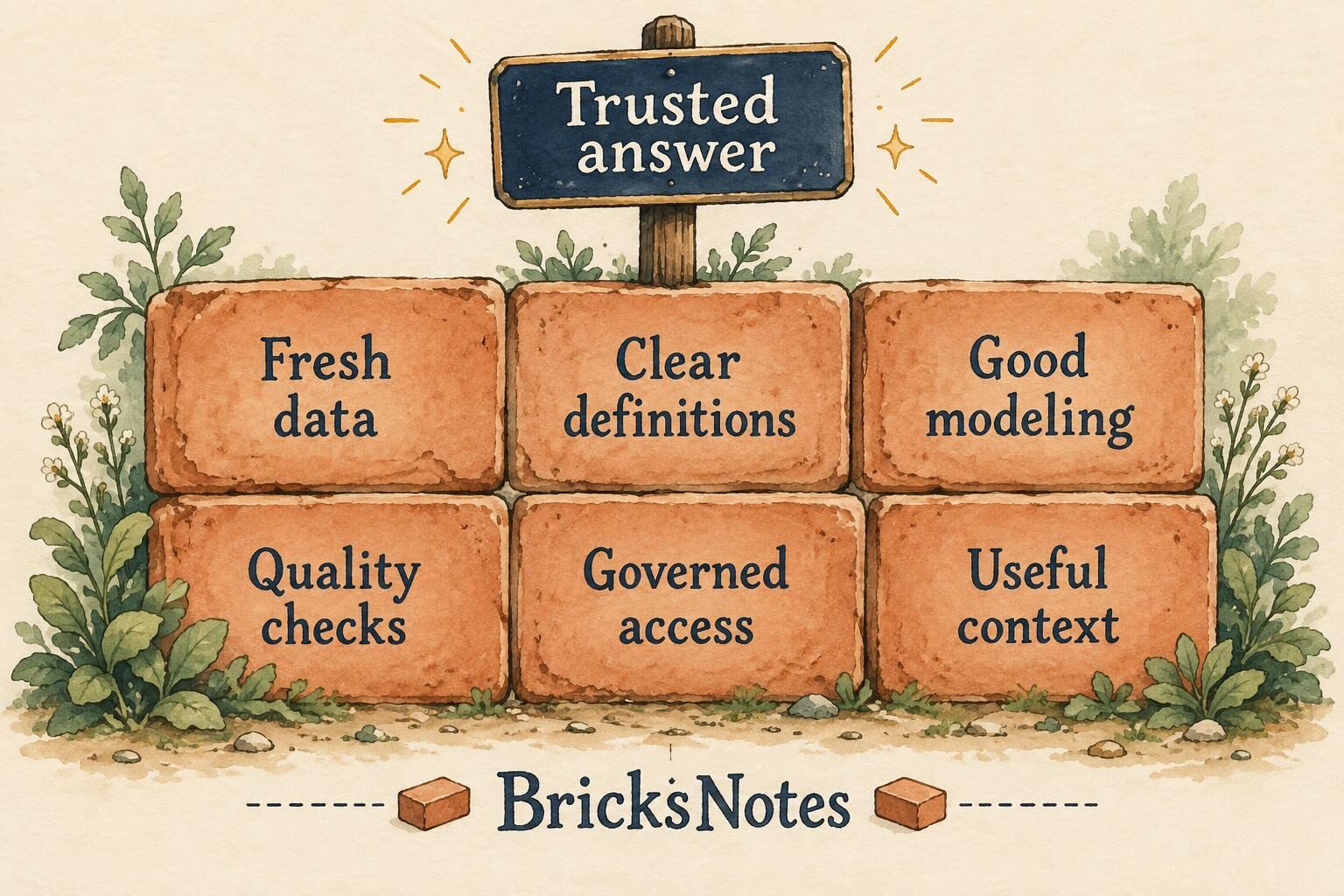
Fresh data. An answer is only as current as the last successful load. If a table stopped updating on Thursday, the assistant will still answer on Monday, and it will not mention the gap. Freshness is not a nice extra. It is part of correctness.
Clear definitions. If finance, sales, and the support team each define an active customer differently, the assistant has to pick one. It may pick a different one tomorrow. Shared definitions are what make two people asking the same question get the same number.
Good modeling. A well shaped table is easier to reason about, for a person and for a model. Clear grain, sensible names, no columns that mean three things depending on the row. Most confusing answers trace back to a confusing table.
Strong quality checks. Duplicates, late arrivals, nulls that used to be zeros. These do not announce themselves. They quietly shift totals. Expectations and simple counts catch them before a decision does.
Governed access. An assistant that can reach a table can reach every row in it, unless you decided otherwise. Permissions, row filters, and column masks are what let you open data up without opening everything up.
Useful context. A column called status_cd with values 1 through 6 means nothing to a model. Descriptions, business terms, and lineage are what turn a warehouse into something answerable.
Get these six right and AI makes your organisation faster. Get them wrong and AI makes your organisation confidently inconsistent.
The tools will keep changing
Look back at the last fifteen years of this work. MapReduce, then Spark. Hand tuned clusters, then serverless. Nightly batch, then streaming. Dashboards, then notebooks, then chat, now agents.
Every one of those shifts was described as a replacement for the last. Every one of them still needed fresh, clear, checked, governed data underneath.
That is the pattern worth trusting. Interfaces change often. The requirement for trustworthy inputs has never changed once.
Data engineering is not competing with AI. It is what decides whether AI is useful.
We wrote about the same idea from the AI side in why AI needs enterprise context and in Genie One MCP. Both land in the same place. The model is rarely the weak point. The meaning and the plumbing underneath it are.
Try it in Free Edition
You can feel this in about ten minutes on Databricks Free Edition. The point is to watch a reasonable answer go wrong on its own.
Create a small orders table with two ordinary problems in it. One order is recorded twice. One has a missing status.
CREATE OR REPLACE TABLE workspace.default.trust_orders AS
SELECT * FROM VALUES
  (1, 'Acme',     5000, 'paid',  DATE'2026-09-10'),
  (2, 'Globex',   3000, 'paid',  DATE'2026-09-12'),
  (2, 'Globex',   3000, 'paid',  DATE'2026-09-12'),
  (3, 'Initech',  4000, NULL,    DATE'2026-09-14'),
  (4, 'Umbrella', 2500, 'paid',  DATE'2026-09-20')
AS orders(order_id, customer, amount, status, order_date);
Now ask the obvious question, the way an assistant would.
SELECT SUM(amount) AS revenue
FROM workspace.default.trust_orders
WHERE status = 'paid'
You get 13,500. It looks fine. It is wrong twice over. The duplicate order was counted, and the missing status silently dropped a real 4,000 order.
Now run the checks you would want before believing any of it.
SELECT
  COUNT(*)                                  AS row_count,
  COUNT(DISTINCT order_id)                   AS distinct_orders,
  SUM(CASE WHEN status IS NULL THEN 1 END)   AS missing_status,
  MAX(order_date)                            AS newest_order
FROM workspace.default.trust_orders
Five rows, four orders, one missing status. That is the whole story, and it took one query.
Then give the answer a home that handles both problems in the open.
CREATE OR REPLACE VIEW workspace.default.revenue_official AS
SELECT SUM(amount) AS revenue
FROM (
  SELECT DISTINCT order_id, amount, status
  FROM workspace.default.trust_orders
)
WHERE status = 'paid'
Anyone who queries revenue_official now gets 10,500, and the rule they are trusting is written down instead of remembered.
In a paid workspace you would go further, with Lakeflow pipeline expectations that fail a run on bad data, and Unity Catalog metric views with named owners. Those features require a paid Databricks workspace. The concepts are explained here for understanding.
If tables and views are new to you, the free BricksNotes lessons start from the beginning, and the PySpark tutorial for beginners covers the same ground in Python.
Looking at it through the 4Cs
At The Context Advantage we read every Data + AI change through four questions. This one is a clean fit.
Context. Descriptions, business terms, and lineage are what let a model answer in your language instead of guessing at column names.
Control. Permissions and audit decide who can ask what, and let you explain afterwards how a number was produced.
Cost. Bad data is expensive twice. Once in the wasted compute and retries, and again in the decisions made on top of it.
Choice. Open formats and clean models mean you can change assistant, model, or vendor next year without rebuilding the foundation.
What to do this week
You do not need a programme for this. Pick one table that a lot of people rely on and answer four questions about it.
When did it last update, and how would you know if it stopped? Who owns the definition of its most important number? What check would have caught last month's surprise? Who can read it today that probably should not?
If any answer is a shrug, that is your next piece of work. It will do more for trust than any new tool.
The BricksNotes view
AI has made answers cheap. It has not made them trustworthy.
Trust still comes from the unglamorous work. Data that is fresh, words that mean one thing, tables shaped clearly, checks that fail loudly, access that is deliberate, and context written down for whoever asks next.
That work does not get less valuable as the tools get better. It gets more visible, because now something fast and confident is standing on top of it.
Brick by brick.
Keep going with what changes when AI agents reach trillion-token scale, or read how governed spreadsheets change who owns the numbers.