Your Spreadsheet Is Becoming an AI Interface. That Changes Who Owns the Numbers.
Databricks bought Row Zero to bring governed spreadsheets into Genie. The real story is who defines revenue.
It is Monday morning. The finance lead opens three spreadsheets before the board meeting.
One says revenue last quarter was 12.48 million. Another says 11.89 million. The board deck says 13.25 million.
Nobody made a mistake with a formula. Each sheet is correct by its own rules. One counts refunds. One counts only paid invoices. One includes a deal that closed on the last night of the quarter.
The real problem is not the math. The problem is that three people own three different meanings of the same word.

Why spreadsheets never went away
Spreadsheets are more than forty years old. They are still the most used analytics tool in business.
That is not because people are behind the times. A spreadsheet lets you think with your hands. You can change one number and watch the whole model move. No ticket, no waiting, no new tool to learn.
Data teams have tried for years to replace them with dashboards. The dashboards got built. The spreadsheets stayed.
So the useful question is not how to get rid of spreadsheets. The useful question is how to stop them from quietly drifting away from the truth.
What Databricks announced
On September 24, 2026, Databricks announced that it acquired Row Zero, a cloud spreadsheet built to handle very large datasets.
The stated plan is to bring a native, governed spreadsheet experience into Genie. That spreadsheet would sit on the same business context as the rest of Genie, through Genie Ontology, Unity Catalog, and Unity Gateway.
TechCrunch reported a nice detail. The Databricks finance team was already using Row Zero with Genie before the deal. The idea came from real daily work, not from a slide.
This is an announced direction, not a feature you can click today. The spreadsheet experience inside Genie is still being built. Treat anything specific as a plan until it ships.
The part AI cannot fix by itself
It is tempting to think AI will solve the three-spreadsheet problem. Just ask the assistant what revenue was.
But think about what the assistant actually sees. If "revenue" means three things in three places, the AI will pick one. It may pick a different one tomorrow. It will sound confident either way.
AI makes spreadsheets faster. It does not make competing definitions agree.
A faster answer built on an unclear definition is just a faster argument.
This is the same lesson we saw in Genie One MCP and in why AI needs enterprise context. The model is rarely the weak point. The meaning underneath it is.
The new shape of a spreadsheet
Here is the model that the Row Zero plan points toward. It has four layers.
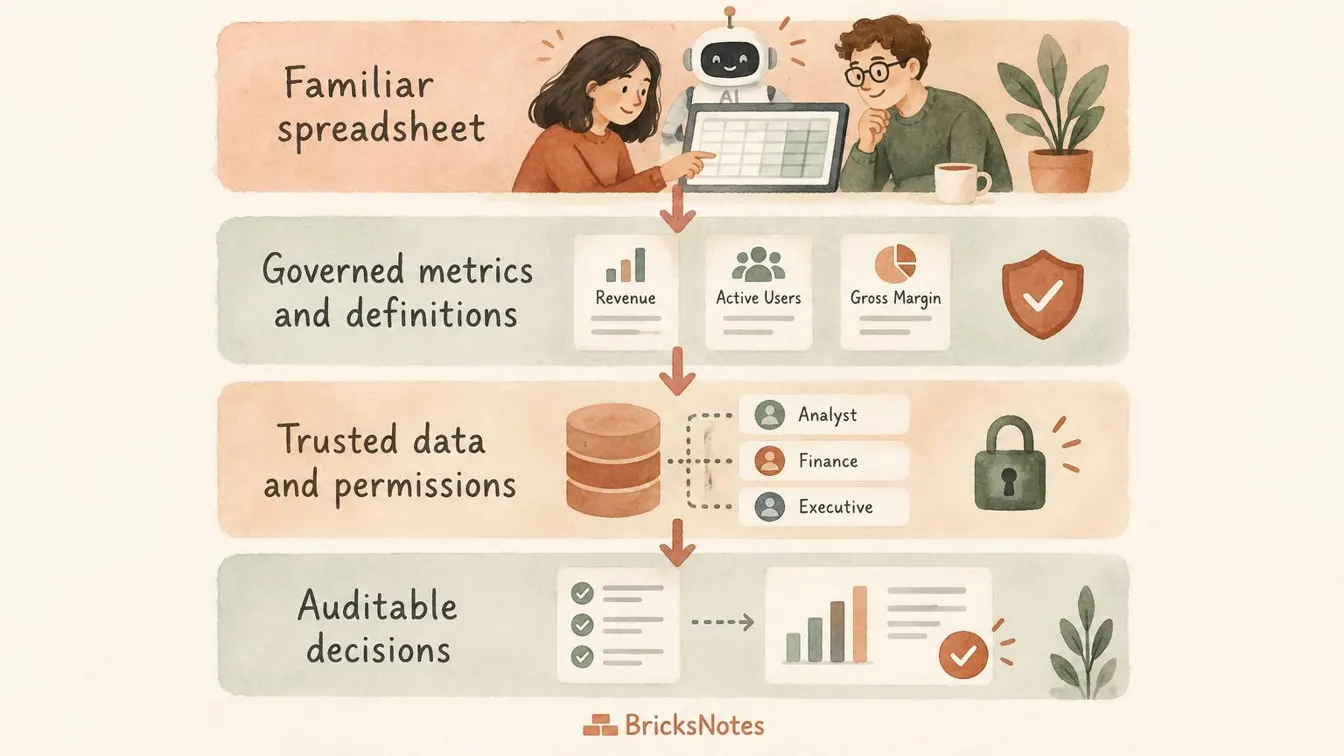
At the top is the familiar grid. People and AI assistants both work there. Formulas, scenarios, and quick what-if questions all stay.
Under that sits a layer of governed metrics. "Revenue," "active customer," and "gross margin" are defined once, in one place, by people who own them.
Under that is the trusted data itself, with permissions. A sales rep and a CFO can open the same sheet and see only what they are allowed to see.
At the bottom is the audit trail. When a number drives a decision, you can trace where it came from.
The spreadsheet stops being a copy of the data. It becomes a window onto it.
Looking at it through the 4Cs
At The Context Advantage, we look at every Data + AI change through four questions. They fit this one well.
Context. The spreadsheet uses the same business terms as everyone else. "Revenue" means one thing across finance, sales, and the AI assistant.
Control. Permissions, lineage, and audit follow the data into the sheet. No more emailing a file with salary columns hidden but not deleted.
Cost. The quiet cost of spreadsheets is reconciliation. Hours spent each month asking why two numbers differ. Shared definitions remove most of that work.
Choice. People keep the tool they already like. The data team does not need to force everyone into a new interface to get trust.
Try it yourself in Free Edition
You do not need a paid workspace to feel this problem. You can recreate it in a few minutes in Databricks Free Edition.
Open a new notebook and create a small orders table.
CREATE OR REPLACE TABLE workspace.default.quarter_orders AS
SELECT * FROM VALUES
  (1, 'Acme',   5000, 'paid',     false, DATE'2026-09-10'),
  (2, 'Globex', 3000, 'paid',     true,  DATE'2026-09-15'),
  (3, 'Initech',4000, 'invoiced', false, DATE'2026-09-30'),
  (4, 'Umbrella',2500,'paid',     false, DATE'2026-09-20')
AS orders(order_id, customer, amount, status, refunded, order_date);
Now write "revenue" three ways, the way three different spreadsheets would.
SELECT
  SUM(amount) AS revenue_all_orders,
  SUM(CASE WHEN status = 'paid' THEN amount END) AS revenue_paid_only,
  SUM(CASE WHEN status = 'paid' AND NOT refunded THEN amount END) AS revenue_paid_no_refunds
FROM workspace.default.quarter_orders
You will see 14,500, 10,500, and 7,500. Same table. Three honest answers.
Now pick one definition and give it a home everyone can reuse.
CREATE OR REPLACE VIEW workspace.default.revenue_official AS
SELECT
  SUM(amount) AS revenue
FROM workspace.default.quarter_orders
WHERE status = 'paid'
  AND NOT refunded
Anyone who queries revenue_official gets the same number. That is the small version of a governed metric.
In a paid workspace, Unity Catalog metric views take this further with owners, descriptions, and reusable measures. That feature requires a paid Databricks workspace. The concept is explained here for understanding.
If you are new to tables and views, the free BricksNotes lessons walk through this step by step.
What this means for you
If you are a data engineer, your job is moving closer to the business. The most valuable thing you can build may not be a pipeline. It may be one clear, owned definition of a number people argue about.
If you work in finance or operations, the good news is you probably keep your spreadsheet. What changes is where the numbers underneath come from.
Either way, a good next step is simple. Pick the one metric your team disagrees on most. Write down every definition in use. That list is the start of your governed layer.

The BricksNotes view
The spreadsheet is not dying. It is becoming the place where people and AI meet business data.
The winning spreadsheet will not be the one with the cleverest AI formulas. It will be the one that uses trusted definitions and leaves a clear trail behind every decision.
That was always the hard part. AI just made it impossible to ignore.
If you want to keep going, read how AI agents change architecture at trillion-token scale, or start with the PySpark tutorial for beginners and build the data layer these spreadsheets will stand on.