The answer is only the beginning: how shared context turns insight into action
Genie One can help people move from a business question to a governed next step. The foundation is not a better prompt. It is shared context.
Most enterprise AI projects begin with a modest promise: help people get answers faster.
That is useful. It is also only the first step.
A sales leader asks, "Why did revenue fall in the West region?" The AI finds a decline in renewals and identifies three large customer accounts behind most of the change.
The answer creates the next question.
Which customers were affected? Which accounts are at risk now? Who owns those accounts? Has anyone contacted them? What should happen next? How will we know whether the response worked?
The user is no longer asking for information. The user is trying to make a decision.
That change matters because each follow-up depends on the same business meaning. "Revenue," "West region," "at risk," "account owner," and "renewal" need stable definitions. If the context resets after every answer, the user must rebuild that meaning again and again.
This is the larger opportunity behind Databricks Genie One and Genie Ontology. The goal is not simply to make question answering better. It is to reduce the distance between a business signal and a trusted action.
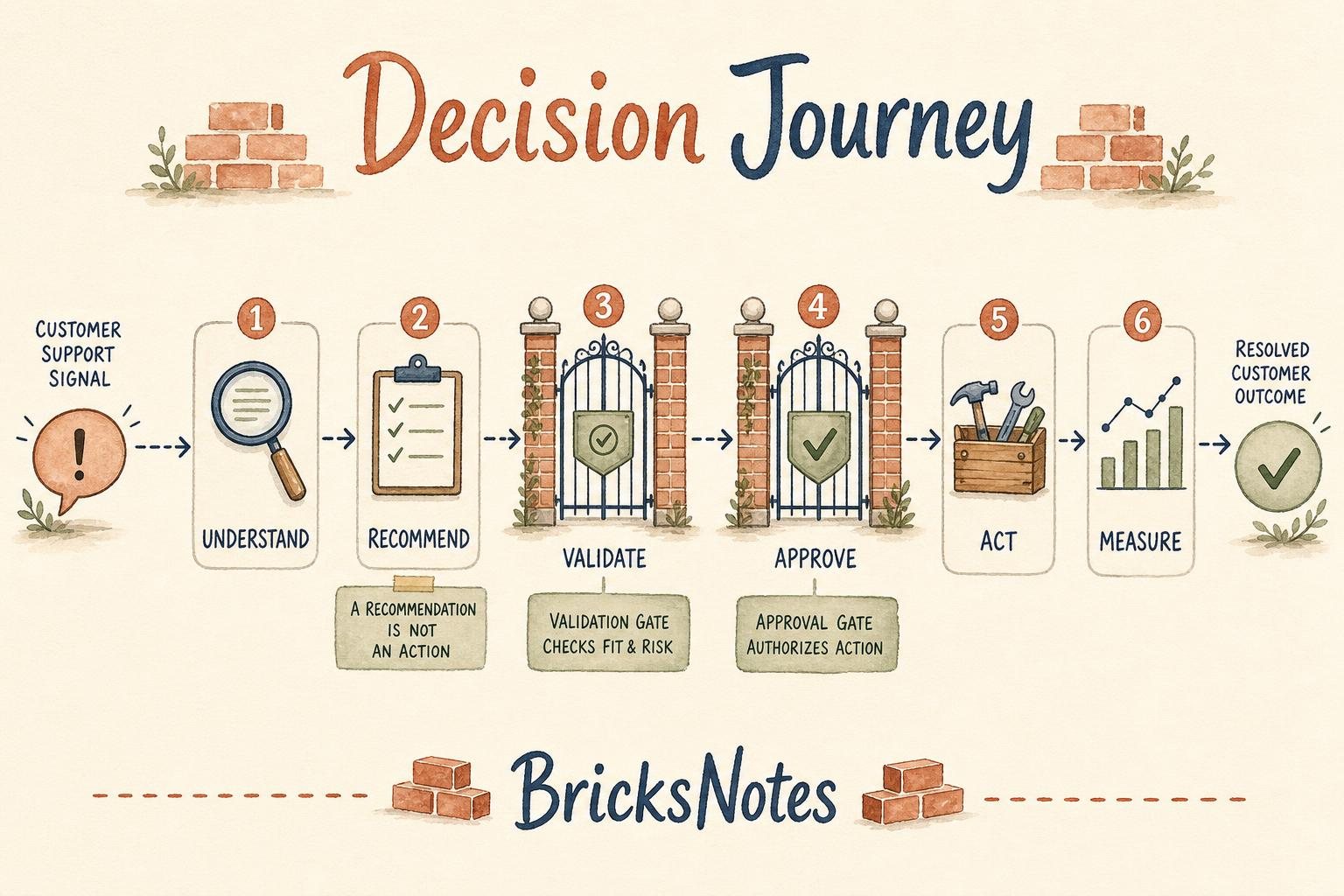
The BricksNotes view: an answer becomes valuable when it can travel safely through understanding, recommendation, validation, approval, action, and measurement.
The hidden cost of starting over
Imagine that the first revenue question is answered by a chat tool.
The next question goes to a dashboard. The account-risk check happens in another application. Ownership comes from a CRM system. A manager approves outreach in a message thread. Someone later measures the result in a notebook.
Each tool may work correctly on its own. The problem is that each one may carry a different understanding of the business.
One tool may define revenue as invoiced revenue. Another may use recognized revenue. One may assign customers by billing address. Another may use the sales territory attached to the account owner. One may call a customer "at risk" after thirty days of inactivity. Another may use a renewal score.
The conversation looks connected to a person. Underneath, the meaning is fragmented.
This is why context is not a prompt-writing detail. It is part of the data architecture.
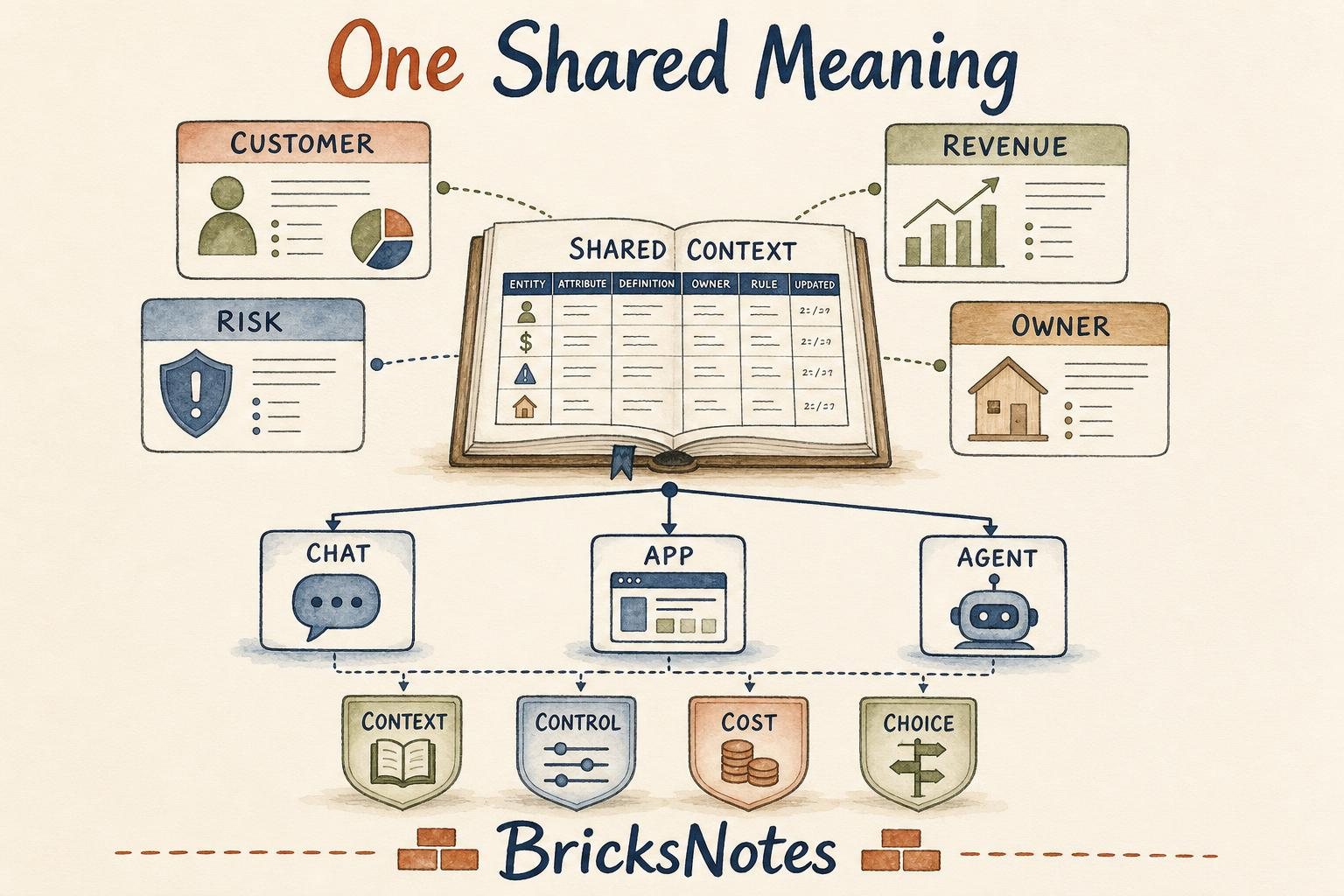
A strong context layer gives every interface a shared map of the business. It connects terms, entities, metrics, owners, rules, permissions, and trusted sources. It helps a chat interface, an application, and an agent interpret the same question in the same way.
What Genie Ontology adds
A traditional catalog can tell you that a table exists, who owns it, and who may query it. Those facts are essential, but business reasoning needs more.
It needs to know that net_revenue is the approved revenue measure for this analysis. It needs to understand that an account is considered at risk only when the customer-health rule is satisfied. It needs to connect the account to its owner, region, open support cases, renewal date, and approved playbook.
Databricks describes Genie Ontology as a living context layer for the Genie family. It combines business semantics governed through Unity Catalog with context inferred from assets such as dashboards, SQL queries, and other Genie resources.
That distinction is important.
Some meaning should be deliberately defined and governed. A finance team should own the approved revenue metric. A support team should define severity. A security team should control who can see sensitive customer records.
Other context can be discovered from how people already work. Frequently used queries, trusted dashboards, and current assets can reveal useful relationships. Databricks says inferred context snippets are ranked using signals such as source authority, use, and freshness.
The result is not a static dictionary. It is a governed layer that can become more useful as the business changes.
Genie Ontology is currently in Public Preview and requires a paid Databricks workspace. The feature is explained here for understanding. You can still practice the underlying habits in Databricks Free Edition by building clear gold tables, using descriptive names, and documenting business rules.
For a hands-on starting point, read the book lesson on Genie Spaces. It shows why table selection, descriptions, example questions, and readable SQL matter before any wider agentic workflow can be trusted.
Genie One is not just another question box
Genie One is designed as a data-smart AI coworker. It uses shared business context to support questions, reasoning, and next steps across the places where people already work.
The useful shift is from isolated query generation to a continuing decision journey.
A person should not need to explain what a customer means in chat, explain it again in an application, and explain it a third time to an agent. The interface can change while the governed meaning remains stable.
This does not mean that every answer should trigger an action.
It means the answer can become the start of a controlled process instead of the end of a disconnected conversation.
Watch the explainer
The video below walks through the move from question answering to shared context and trusted action.
https://youtu.be/RM7ndijT5lA
A support signal becomes a decision
Consider a customer-support team.
A leader asks, "Why did priority escalations increase this week?"
The system finds that escalations rose among enterprise customers after a product change. That is the understand stage. The AI has connected support cases, customer tiers, release history, and the team's definition of a priority escalation.
Next it recommends a response. It may suggest assigning a specialist, contacting the affected customers, or pausing a rollout for a specific segment.
That is useful decision support. It is not yet an action.
A recommendation is a proposal based on evidence. An action changes business state.
Sending a customer message, changing an account owner, issuing a service credit, or pausing a rollout creates a real consequence. The action needs the correct permission, current data, policy checks, and sometimes human approval.
This is the boundary where many AI demonstrations become unreliable systems.
The answer may be persuasive. The recommendation may sound sensible. Neither fact gives the model authority to change the business.
The difference connects directly to our article on AI agent memory versus business state. Memory helps an agent reason about the conversation. A governed system of record tells the organization what is actually true.
The six stages from signal to outcome
The following framework is a BricksNotes teaching model. It is not an official Databricks product framework. It helps us see where shared context, controls, and human judgment belong.
1. Understand
The system identifies what happened and why it matters.
This requires more than retrieving rows. It needs trusted metrics, relationships, definitions, and access rules. It should be able to explain which sources supported the answer.
For the support example, understanding may connect escalation volume, customer tier, product release, account health, and case history.
2. Recommend
The system proposes one or more next steps.
A good recommendation states its evidence and assumptions. It should also make uncertainty visible. "Contact these accounts" is stronger when the user can see why those accounts were selected and which rule classified them as at risk.
The recommendation belongs beside the data, not above it as an unexplained opinion.
3. Validate
The proposed next step is checked against current facts, business rules, and risk.
Is the account still at risk? Has another team already contacted the customer? Is the proposed service credit within policy? Is the supporting data fresh enough?
Validation protects the process from stale context and conflicting activity.
This stage is also where data engineering becomes visible. Reliable Delta Lake tables, clear data quality checks, and well-modeled gold data are not background details. They are what make validation possible.
4. Approve
The right person or policy authorizes the action.
Low-risk, reversible actions may follow an automated rule. High-impact actions may require a manager, finance owner, or compliance reviewer.
Approval is not a sign that the AI failed. It is a designed control.
Unity Catalog provides the wider governance foundation for data and AI assets. Permissions should follow the person and the resource. An agent should never gain broader access simply because it can describe a useful action.
5. Act
Only now does the system make a controlled change.
It may create a case, notify an owner, draft an approved message, update a workflow, or call an allowed business service. The action should be idempotent where possible, so a retry does not create duplicate credits, tickets, or messages.
The result should be recorded in the system that owns that business state.
A chat transcript is not the official record of a service credit. An agent's memory is not the official account owner. The correct operational system remains authoritative.
6. Measure
The process checks what happened after the action.
Did escalations fall? Did the customer respond? Was the issue resolved? Did the intervention create an unwanted side effect?
Measurement closes the loop. It turns a one-time automation into a learning system.
It also reveals whether the recommendation was helpful, whether the context was complete, and whether a rule needs to change.
Shared context does not mean one giant prompt
It is tempting to imagine a context layer as a very long set of instructions placed before every question.
That approach does not scale.
A governed context layer should retrieve only what is relevant to the user, task, and permission boundary. It should preserve ownership and provenance. It should resolve conflicts carefully. It should allow important definitions to be certified instead of treating every discovered snippet as equally true.
This is one reason Genie Ontology matters. Databricks documentation describes both governed semantics and inferred snippets. It also describes permission checks and citations that help a person inspect which sources supported an answer.
The practical lesson is broader than any single product.
Good enterprise context has structure.
It includes the entities the business cares about, the relationships between them, the meaning of important metrics, the policies that constrain decisions, the people who own definitions, and the history needed to judge freshness.
A model supplies general intelligence. Context connects that intelligence to this company, this user, this decision, and this moment.
The same meaning can serve three experiences
A shared context layer becomes especially valuable when the organization builds more than one AI experience.
A chat interface may help a leader investigate a revenue signal.
An application may show the affected accounts, supporting evidence, and an approval control.
An agent may perform an approved task and monitor its result.
These experiences should not invent separate definitions of revenue, customer risk, ownership, and policy. They should draw from the same governed meaning while applying controls appropriate to each interaction.
This is the architectural connection between Genie Ontology, Genie One, applications, and agents.
The user experience can change. The context should remain coherent.
The 4Cs behind trusted action
This journey maps naturally to The Context Advantage and its four connected concerns: Context, Control, Cost, and Choice.
Context
The system needs the right business meaning, trusted data, relationships, history, and current situation.
Without context, the answer may be fluent but irrelevant.
Control
The system needs permissions, approval rules, audit history, and clear boundaries between recommendation and action.
Without control, a useful suggestion can become an unsafe change.
Cost
The organization needs to decide how much context to retrieve, which models to use, which steps need automation, and which actions justify the expense.
Without cost awareness, a workflow can be technically impressive and economically poor.
Choice
The architecture should not trap business meaning inside one interface or one model. Shared context should support different models, applications, and agents as needs change.
Without choice, today's convenient shortcut can become tomorrow's constraint.
Together, the 4Cs turn the discussion away from "Which model is smartest?" and toward a more useful question: "What must be true for this decision to be trusted?"
What data engineers own in this future
The emergence of context layers does not reduce the importance of data engineering. It raises the standard.
An AI system cannot infer a reliable customer view from five contradictory identifiers. It cannot apply an approved revenue definition when every dashboard calculates the metric differently. It cannot validate an action against a table that arrives late without anyone noticing.
Data engineers create the conditions that make context dependable.
That work includes stable identifiers, tested transformations, explicit ownership, freshness signals, understandable schemas, reliable incremental processing, and a clear separation between raw evidence and business-ready data.
The medallion architecture remains useful here. Bronze preserves the source evidence. Silver creates dependable entities and relationships. Gold expresses the business meaning that people and AI systems can use.
The context layer does not replace that foundation. It makes the foundation easier to reason over.
A practical path for teams
Do not begin by connecting every domain and automating every action.
Choose one recurring decision with a clear owner.
Write down the terms that people argue about. Identify the trusted sources. Define the current metric and risk rules. Record who may see the data and who may approve the action.
Then test the journey one stage at a time.
Can the system explain the signal correctly? Can it recommend a reasonable next step? Can a person inspect the evidence? Can the workflow validate current state? Can the right owner approve it? Can the action be retried safely? Can the outcome be measured?
This approach creates trust through observation rather than promises.
Databricks recommends building ontology capability progressively, starting with the data foundation and business semantics, then curating trusted assets, applying governance, and improving through evaluation. That matches the practice-first approach of the BricksNotes book.
In Databricks Free Edition, you can begin with the parts that matter most: create a small gold table, use clear column names, document the metric, write a few known-answer questions, and inspect the SQL generated by a Genie Space.
The broader Genie One and Genie Ontology capabilities require a paid workspace. The concept is explained here so you understand where the architecture is going before you need to operate it.
From recurring questions to trusted agents
The path to useful agents is usually less dramatic than the demos suggest.
A team begins with a recurring question.
The question becomes a reliable analysis.
The analysis supports a decision.
The decision becomes a governed workflow.
The workflow becomes a candidate for agent assistance.
At each step, the organization learns what context is missing, which controls matter, how much the process costs, and where human judgment remains necessary.
That is how trusted automation grows.
Not by removing people from the loop as quickly as possible, but by making the loop clear enough that responsibility can be assigned deliberately.
The real opportunity
Better question answering is valuable. It saves time and opens data to more people.
But the larger opportunity begins after the answer.
Shared, governed context lets the same business meaning move through analysis, recommendation, validation, approval, action, and measurement. It lets chat, applications, and agents work from a coherent foundation. It gives people a way to inspect the evidence before the system changes anything real.
The goal is not maximum automation.
The goal is minimum distance between a meaningful signal and a trusted action.
That is the difference between an AI tool that gives impressive answers and an AI system that helps a business move with confidence.
Continue learning
Start with Genie One explained for the product foundation, then read AI agent memory versus business state for the boundary between reasoning and truth.
Practice the foundations in the book lessons on Genie Spaces, Unity Catalog, data quality, and medallion architecture.
For the wider enterprise AI view, continue with The Context Advantage. The 4Cs provide a durable way to judge any agent architecture, even as products and model names change.